What is tax resolution software?
Most tax resolution software is a case database with a forms library. It can record that work happened. It cannot standardize the work, evidence it, or hand your client a deliverable that defends the fee. Brevitax is built around the work product.
What firms actually buy tax resolution software to do
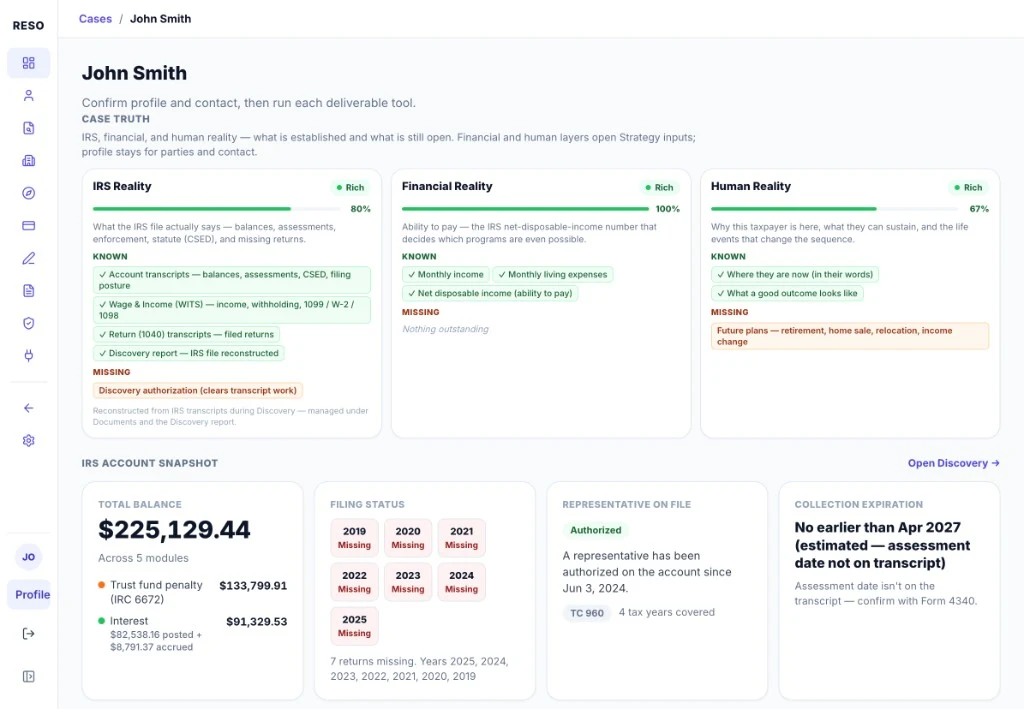
Nobody buys software to admire case statuses. Firms buy it to run engagements: qualify the lead, ground the case in IRS evidence, analyze the financials, choose and sequence a resolution, implement it, and keep the client when expectations shift. The software question is whether your standard survives every one of those steps — on every case, under every operator.
- Structured intake and consultation on a case record, not scattered notes
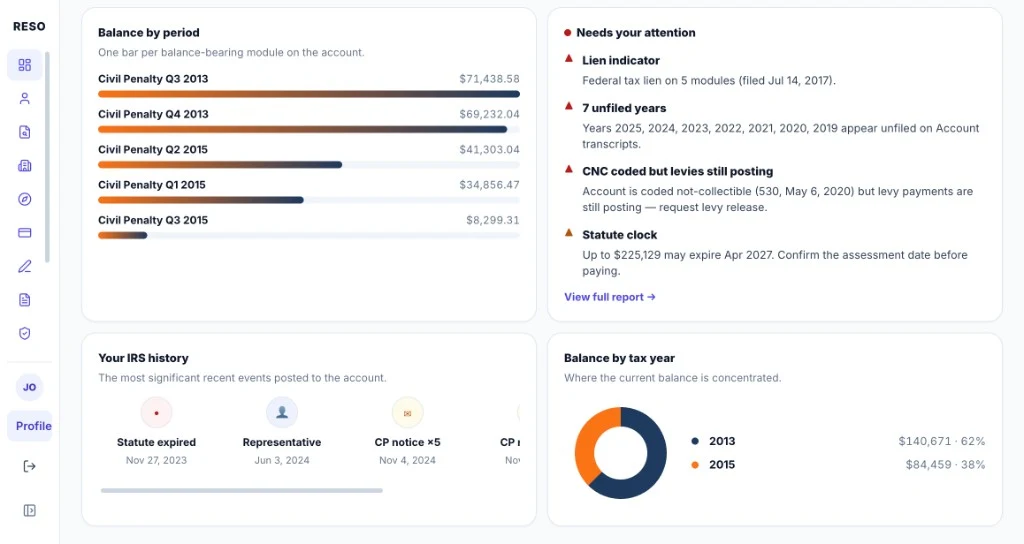
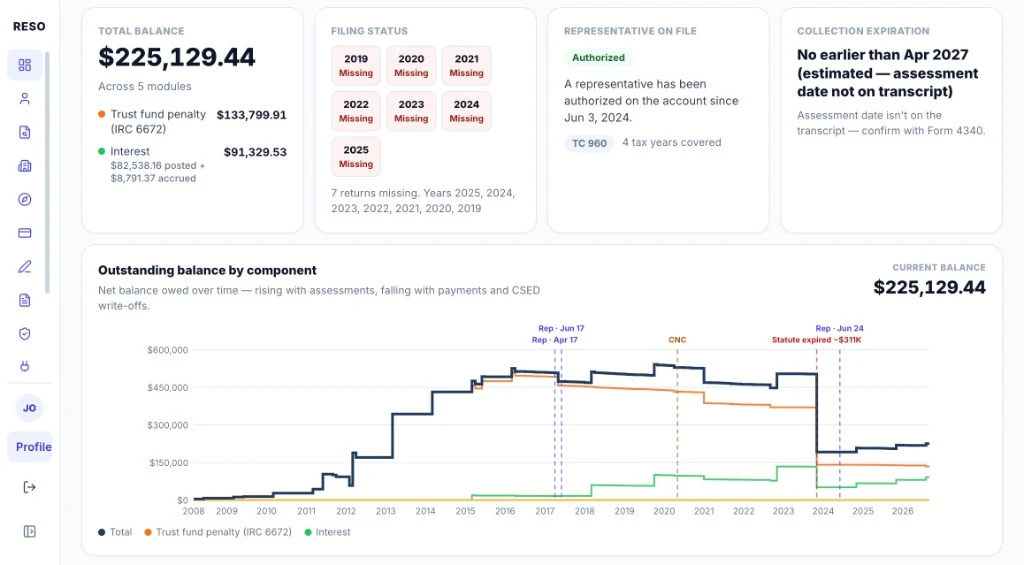
- IRS transcripts pulled in, decoded, and tied to the case as evidence
- Financial analysis that supports program eligibility and pricing
- Client deliverables, e-sign, portal, and invoicing on the same engagement
- A record of work performed when the fee is questioned
Where traditional tax resolution software stops
The established tools in this category are database UI layers: contact records, case statuses, document folders, and a library of fillable forms. Useful — and structurally incomplete. Three things never make it into the database:
- The analysis. Transcripts sit in a folder as PDFs; the conclusions live in whichever operator read them.
- The methodology. The standard of work lives in training and memory, so it varies by employee and leaves with turnover.
- The proof. A status field that says “Closed” records an opinion. It is not evidence of work performed, and it will not defend a fee.
What to demand instead
- One governed case record from first conversation through retention — not a CRM record with attachments
- Transcript-grounded analysis that lands in a reviewable deliverable, not in someone’s head
- The same workflow on every case, regardless of which employee opens it
- Source-of-truth discipline: IRS record facts, client narrative, and financial profile kept distinct — so contradictions surface instead of blending
- Attestation of steps performed, tied to the evidence behind each one
- Deliverables your firm can present, bill, and later defend
The deliverable chain
Brevitax treats the engagement as a chain of three defensible work products — each one tangible, co-branded, and preserved on the case record:
- Discovery Work Product — IRS posture, urgency, program fit — advisory-grade diagnosis your firm can bill for.
- Resolution Work Product — Option ordering, sequencing, and implementation roadmap tied to the same case record.
- Work Verification Record — Evidence of work performed — fee defense and retention when expectations shift.
The economics
A more repeatable practice is a more profitable practice.
- Discovery and Strategy deliverables → sold as advisory revenue per case, or used uncharged to close implementation on findings
- Documented work product → fewer refunds · stronger fee defense · fewer chargebacks
- One standard per case → fewer bad quotes · less partner rework · faster onboarding
What Brevitax is not
- Not a CRM
- Not a transcript reader
- Not a forms library with statuses
- Not an AI chat wrapper
- Not taxpayer self-serve DIY
Frequently asked questions
What is tax resolution software?
Tax resolution software helps firms run IRS resolution engagements: intake, transcript analysis, financial profiling, program evaluation, implementation, and client billing. Traditional tools focus on case storage and forms; Brevitax Pro and Office are built around standardized workflow and defensible deliverables — Discovery, Strategy, and Work Verification — on one governed case record. Pro is $79/mo per seat with unlimited cases.
How is Brevitax different from case management software?
Case management software records that work happened — statuses, tasks, document folders. Brevitax produces the work itself: transcript-grounded analysis that lands in billable deliverables, the same methodology enforced on every case, attested steps, and a verification record that defends the fee when it is questioned.
Does Brevitax replace our CRM?
No. Pipeline and marketing stay in your CRM. Brevitax owns the engagement from transcripts through retention. Most firms adopt with a parallel run — every new case starts on Brevitax, and legacy matters move when they next touch.
Who is tax resolution software like Brevitax for?
Brevitax Pro and Office serve tax resolution firms, enrolled agents, CPAs, tax attorneys, preparers, and resolution sales teams. Solo practitioners start on Pro. Brevitax Personal is the separate household edition.
What tax resolution software should actually do
Category software should shorten the path from IRS records to a defensible recommendation. That requires transcript parsing, reconciliation signals, financial qualification inputs, and deliverables clients can understand — without forcing practitioners to become data entry clerks.
Transcript-first beats template-first
Templates assume the case shape. Account transcripts reveal what the IRS actually posted: assessed balances, module status, enforcement codes, and timing that affects levy, lien, and collection statute analysis. Brevitax starts from parsed transcript reality, then layers household economics and client context.
- Account, wage and income, and return transcripts feed one case timeline.
- Business transcripts (BMF) surface payroll and entity compliance gaps practitioners often miss on intake.
- Work Verification ties recommendations to later account refreshes.
Who benefits most
Solo enrolled agents adding representation work, multi-practitioner resolution firms, and owners who need margin protection all need the same foundation: fewer re-reads, faster quoting, and documentation that survives client scrutiny.