
Real IRS data
Not just what you were told.
INDEPENDENT. OBJECTIVE. CLEAR.
See what’s been done, what’s still open, and what to do next — based on your actual IRS records.
Brevitax helps you review IRS records, spot completed work, identify open items, and understand what may still be affecting your case.
7-day trial · card required · cancel anytime. Results in 24–48 hours.
Built for taxpayers who already hired help — or want a second opinion.
Reviewed August 2026 · Joseph Lancaster, Founder
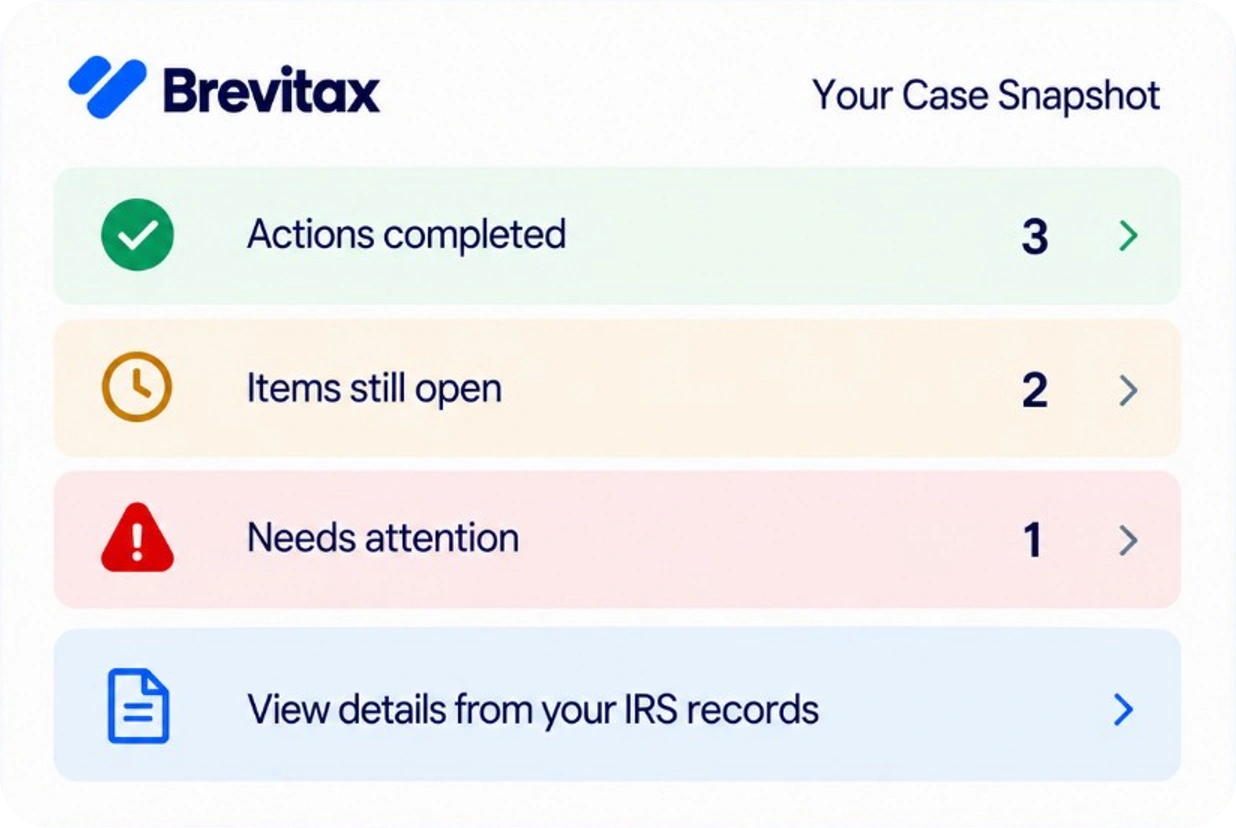
Not just what you were told.
Get the facts.
Know what to do next.
Move forward with confidence.
Verification may be useful when you want an independent picture of your IRS account — especially before paying another firm or assuming the prior engagement failed.
IRS account records can help you compare what you were told with what currently appears on your account. For deeper explanations of transcript fields, see our account transcript guide and transaction code reference.
| Question | What you are looking for | Where evidence may appear |
|---|---|---|
| Did a tax return post? | Filing and account information for the tax year in question. | IRS account transcript and other appropriate IRS records. |
| Did a payment post? | Payment amount, date, tax period, and account to which it was applied. | IRS account transcript. |
| Did the balance change? | Assessments, payments, credits, abatements, adjustments, and accrued amounts. | IRS account activity by tax year and module. |
| Is an installment agreement reflected? | Account activity, IRS correspondence, payment behavior, and other confirmation. | Account transcript, notices, and payment history. |
| Was a penalty adjusted? | Adjustment transactions and resulting balance changes. | Account transcript posting sequence. |
| Does collection activity still appear unresolved? | Notices, balance posture, filing status, and collection-related indicators. | Account records, correspondence, and current balance by year. |
Tax professionals and taxpayers often use the word "filed" loosely. For verification, it helps to separate stages:
IRS account and return transcripts may help you see whether a return appears for a given tax year. Processing delays are common, and a return that was submitted recently may not yet appear. The absence of a posting does not by itself prove a return was never submitted. Look for TC 150 on the account transcript; if income documents exist but no return posted, a wage & income transcript can show what payors reported.
See how to get IRS transcripts for request options.
Compare what you believe was paid against what the IRS account shows: payment amount, payment date, tax year, tax type, and the account to which the payment was applied. Posted payments often appear as TC 670 on your account transcript.
Payments can sometimes post to a different tax period or module than you expected — especially when multiple years or business modules are involved. Year-by-year account review usually works better than relying on a single total balance.
This article is educational information, not individualized tax advice.
At a high level, compare what you were told was requested or established with IRS account activity, notices, payment behavior, and any written confirmation you received.
Possible situations to review may include:
Not every action appears instantly or through one specific transcript line. Verification may require account records, IRS notices, correspondence, payment history, follow-up records, and in some cases direct IRS confirmation. Our transcript codes guide explains common posting events like installment agreements (TC 971), CNC (TC 530), and offers (TC 694/780).
Possible explanations include:
Verification before drawing conclusions can help you decide what actually needs attention next. Our IRS notices explained hub may help interpret common letter codes.
Balances can exist separately by tax year and tax type. Payments and adjustments may change individual years differently. Penalties and interest may continue to accrue. An aggregate number alone may not explain what happened or what remains open.
Year-by-year visibility matters when you are verifying prior work — you may learn that some years moved while others did not. If you previously hired a tax relief or tax resolution company, Brevitax can help you independently review the resulting IRS account information. Brevitax itself is software for understanding the record, not a tax relief or debt-settlement provider.
Signs that may deserve attention include:
Available IRS records may not show every legal collection status on their own. Active enforcement situations — such as a levy in progress or wage garnishment — may warrant professional representation. Intent-to-levy notices like CP504, LT11, or CP90 should be matched to TC 668 and lien codes on your transcript.
A calm, fact-first process can help:
Verification comes before accusations. The goal is clarity about what the IRS currently shows.
If you are unhappy with a prior tax relief engagement, immediately hiring another firm can mean paying thousands of dollars before you clearly understand what has already been done.
Start with the record.
That sequence helps you decide whether you need new representation, a narrower scope of work, or simply more time for IRS processing — instead of restarting on assumptions alone.
If you previously hired a tax relief or tax resolution company, Brevitax can help you independently review the resulting IRS account information. Brevitax itself is software for understanding the record, not a tax relief or debt-settlement provider.
Brevitax is tax-account software — it helps you organize and understand IRS records so you can compare what a prior provider said with what the account currently shows. It does not negotiate debt, settle balances, or act as your representative before the IRS.

Example account data — not a real taxpayer

For taxpayers who are comfortable reviewing their IRS account in software and taking appropriate steps themselves — not hiring another tax relief firm through Brevitax.
Brevitax guided assistance can help when you want a person to walk through records and paperwork with you. Guided help is separate from tax relief representation or debt settlement.
Organized IRS information can support a clearer discussion with your existing CPA, EA, attorney, or other tax professional.
Some situations may warrant direct professional representation, such as:
Brevitax is software that helps taxpayers organize and understand IRS account information. It is not a debt settlement or debt management service and does not represent taxpayers before the IRS through this product.
IRS account and return transcripts may help you see whether a return appears to have been received or processed for a given year. Processing can take weeks or longer, and a missing line on a transcript does not by itself prove a return was never submitted.
A phone call or letter from a representative may not appear as a single simple event on an account transcript. Form 2848 or 8821 authorization, correspondence you received, and documentation from the provider can all be relevant alongside IRS records.
At a high level, compare what you were told with account activity, scheduled or recurring payments, IRS notices, and any written agreement or IRS confirmation. Different arrangements post differently and may take time to appear.
Receiving another notice does not necessarily mean your prior tax professional did nothing. Notices can be generated before an action posts, only part of the problem may have been addressed, or additional years or modules may still be unresolved.
Gather your engagement agreement and communications, obtain current IRS account information, request documentation of work performed, and consider independent professional advice if you need representation or cannot interpret the records.
Review IRS account information year by year. An overall balance alone may not explain which years moved, which payments posted, or which penalties and interest accrued.
IRS transcripts can show many resulting account events, such as filings, assessments, payments, credits, and certain adjustments. They do not necessarily show every communication or action taken by a representative.
No. A missing or unchanged IRS record by itself does not prove fraud or misconduct. IRS processing delays, rejected submissions, incomplete compliance, timing differences, and other explanations may exist. Verify the facts before drawing conclusions.
Not necessarily. First determine what the prior provider was engaged to do, what the IRS currently shows, and what remains unresolved. That information can help you decide what type of assistance you actually need next.
Use Brevitax to organize balances, notices, and account activity before you decide what professional help you may need next — Brevitax is software for understanding the IRS record, not a tax relief provider.
Check My IRS AccountIf you received a notice or owe back taxes, begin with what the IRS has actually posted. Brevitax organizes account transcripts and explains enforcement posture before you commit to a program or firm.
Marketing pages summarize common situations. Your account may differ. Use a current transcript and, when appropriate, licensed representation before filing or agreeing to a collection alternative.